If you’ve ever asked whether you should neuter your dog, you’ve probably received several different answers. Perhaps you’ve been told it will calm them down, prevent health problems or stop unwanted behaviour. You may also have heard that it’s better to wait until they’re fully grown.
So, how do you decide?
Research gives us a more detailed picture than a simple “yes” or “no”. Spaying and neutering can offer important benefits, but the effects depend on factors including your dog’s breed, sex, age, health and circumstances.
The question is: what is the most appropriate choice for this particular dog?
Why do we spay and neuter dogs?
Preventing unwanted litters is an important reason. But there are medical benefits too. Castration removes the testicles, preventing testicular tumours and helping prevent or treat benign prostate enlargement. Conventional spaying removes the ovaries, sometimes together with the uterus, preventing pregnancy and normally preventing pyometra, a potentially life-threatening uterine infection. Spaying can also reduce mammary tumour risk, although the strength of the evidence and the precise effect of timing deserve more careful discussion than the familiar statistics sometimes suggest. Romagnoli’s 2025 review emphasises that these benefits remain relevant, even as we learn more about potential disadvantages. Research questioning routine early neutering does not mean neutering has become unnecessary.
Why does the age of neutering matter?
Reproductive hormones play a role in your dog’s growth and development, so the timing of spaying or castration deserves consideration. In a study of 35 dog breeds, Hart and colleagues (2020) found that neutering at younger ages was associated with a higher occurrence of certain joint disorders and cancers in some breeds, while others showed no detectable increase in the conditions studied. The findings also differed between males and females of the same breed.
The table below summarises the authors’ suggested neutering ages. “Choice” means the study did not detect an increased risk of the joint disorders or cancers examined at any neutering age, not that every possible health or behavioural effect was assessed. Similarly, “leave intact” reflects the authors’ interpretation of those findings, rather than advice that every dog of that breed should remain unneutered.
Use the table as a starting point for a conversation with your vet. The study examined existing hospital records, so it identifies associations rather than proving that neutering caused the differences observed. Your dog’s health, development, behaviour and risk of unwanted breeding should all help guide the decision.
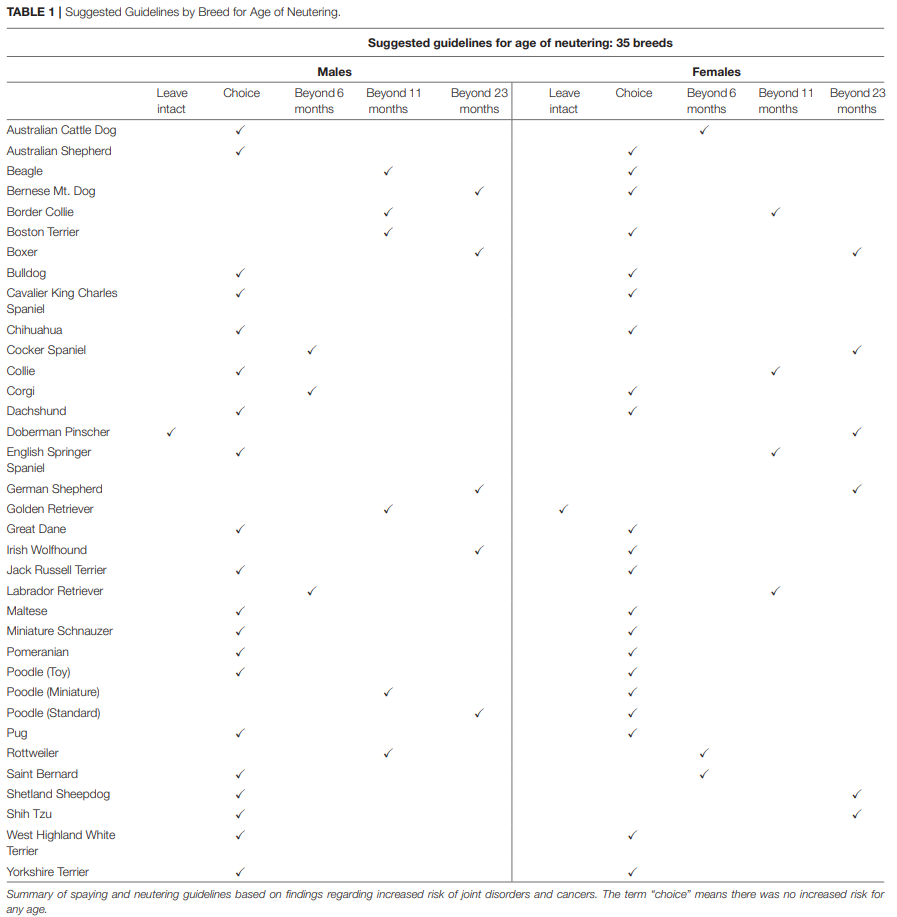
Source: Hart et al. (2020), Table 1, “Assisting Decision-Making on Age of Neutering for 35 Breeds of Dogs: Associated Joint Disorders, Cancers, and Urinary Incontinence.”
Will neutering calm my dog down?
It depends on what you mean by “calm”. If your male dog is intensely interested in females in season, some of that behaviour may be influenced by reproductive hormones. Castration can reduce sexual motivation and associated behaviours in some dogs. But pulling on walks, barking at visitors or struggling to settle should not automatically be treated as a hormone problem. The research reviewed by Vendramini and colleagues describes mixed behavioural outcomes after neutering. Some behaviours may improve, while others may persist or change in less desirable ways. Before deciding, identify the behaviour you want to address and investigate what is driving it. “He needs to calm down” is a starting point for a conversation, rather than a diagnosis.
What about aggression, fear and reactivity?
Neutering should not be promised as a reliable treatment for aggression. The literature includes reports of both improvements and unwanted behavioural changes following surgery. Some studies have also found associations between reduced lifetime exposure to reproductive hormones and higher reporting of certain fear-related or aggressive behaviours. However, these findings need careful interpretation. An association does not prove that neutering caused the behaviour. Dogs differ in their experiences, health, development and reasons for being neutered in the first place. If your dog is nervous, reactive or showing aggression, arrange a veterinary assessment and qualified behaviour support. The decision about neutering should form part of that wider assessment. A fearful dog should not automatically be ruled out for surgery, just as an aggressive dog should not automatically be booked in with the expectation that surgery will resolve the problem.
What should owners of female dogs consider?
For female dogs, the discussion needs to include pregnancy prevention, seasons, phantom pregnancies and reproductive disease. Repeated phantom pregnancies or significant changes around the reproductive cycle are worth discussing with your vet. They can help assess what is happening and advise on treatment and appropriate surgical timing. There are potential drawbacks to consider too. Research has linked spaying with urinary incontinence in some dogs, and the relevance of age, breed and other factors varies across studies. The aim is to balance these concerns against the risks of remaining entire. Delaying surgery should include a practical plan for preventing mating and reviewing your dog’s health.
Does neutering increase cancer risk?
Again, this question needs more detail than a single headline can provide. Removing reproductive organs prevents cancers of those organs. At the same time, studies have reported associations between neutering and an increased occurrence of some other cancers in particular groups of dogs. The findings vary by cancer type, breed, sex and sometimes age at surgery. Romagnoli’s review also highlights conflicting evidence and limitations in the available research. It is therefore misleading to say either “neutering prevents cancer” or “neutering causes cancer” without explaining which cancer and which dogs are being discussed. Ask your vet about the conditions most relevant to your dog and, where possible, their actual likelihood… not just whether a relative increase has been reported.
Remember weight management after surgery
One practical consideration that can get overlooked is nutrition. Vendramini and colleagues highlight an increased tendency towards weight gain after neutering and the importance of adjusting nutritional management. This does not mean your dog will inevitably become overweight. Ask your veterinary team whether their food allowance needs reviewing, monitor weight and body condition, and include training treats in their daily intake.
Are hormone-preserving alternatives an option?
Preventing reproduction and removing reproductive hormones are not always the same thing. A vasectomy prevents a male dog from reproducing while retaining the testicles. An ovary-sparing hysterectomy prevents pregnancy while retaining ovarian hormone production. These procedures have different implications from conventional castration or spaying, and require discussion with a vet familiar with them. Researchers are also investigating how hormonal changes after surgery might relate to longer-term health. For example, Kutzler’s 2020 review explores a possible role for elevated luteinising hormone. This is a proposed explanation for some associations, rather than proof of a single mechanism behind all reported health effects. Hormone-preserving procedures should therefore be considered on their own benefits and limitations, rather than assumed to be the best option for every dog.
Making the decision for your dog
Before your veterinary appointment, think about why you are considering neutering and what you hope it will achieve.
Useful questions include:
Which benefits and risks are most relevant to my dog’s breed, sex and health?
How might the timing affect that balance?
Is the behaviour I’m concerned about likely to be hormone-related?
Would a behaviour assessment help?
Can I reliably prevent unwanted mating if we wait?
When should we review the decision?
Neutering remains a valuable option for many dogs. Research is helping us make more informed decisions about when, how and whether to proceed.
At Treat to Train, we help you understand your dog’s behaviour and develop a practical, reward-based training plan. If behaviour is influencing your decision, we can support you alongside your veterinary team.
This article provides general information and does not replace individual veterinary advice.